


Dear Actioners,
My office will issue this newsletter on a monthly basis, initially, to update you on my key activities as we get deeper into our journey to strengthen ActionSA’s position ahead of the next elections. The newsletter will also feature activities by other ActionSA leaders across the municipalities in which we have established branches and are partnering with other smaller parties for greater impact.
We shall be on the lookout for what Actioners are busy with and regularly highlight inspirational activities they engage in. I call upon all of you, members of ActionSA, to always act with integrity, mindful of our values and our tested, credible, alternative approaches to governance. ActionSA has leaders in it who have proven to be the right people to be given responsibilities to lead our country – one municipality at a time – out of the mess it has been placed in by those trusted to govern, since the end of apartheid.
Through its content, this newsletter will aim to be inspirational, and not negative, because I believe that despite everything that we see around us, thanks to a litany of missed and squandered opportunities, there is still hope to save South Africa again.
ActionSA is determined to lead the way. We do not seek to enter government at any level just to have our turn at the trough, international travel, and blue lights. We shall do so only when we know that we stand a chance to have the positive impact many South Africans expect.
Yours in Action,

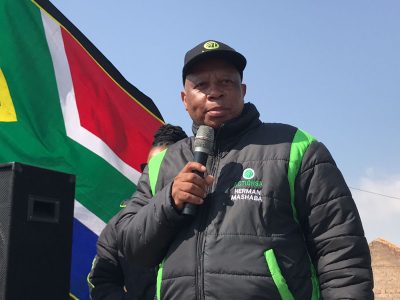
Herman Mashaba
ActionSA President
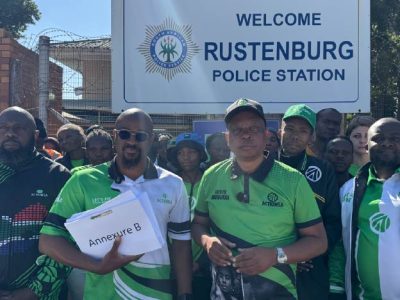
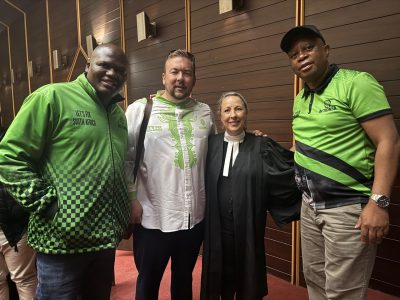
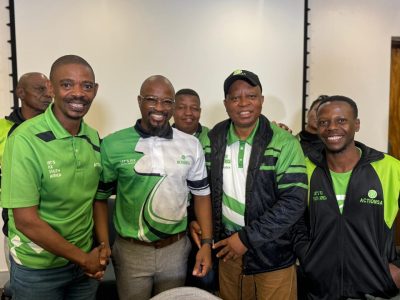
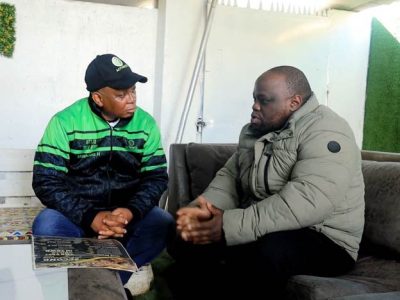

The important question of where ActionSA stands on the issue of human rights as enshrined in the Constitution of South Africa and the Bill of Rights continues to come up in different forums. It is an important one that we intend to continue addressing and questioning, as we cannot afford to have others spreading ill-informed narratives at our expense, particularly the most vulnerable in our country.
As we confront ongoing challenges – from high unemployment to generally worsening service delivery failures, endemic crime, to persistent inequality – we must pause and reflect on the very foundations that are meant to safeguard our dignity and freedom: our Constitution and Bill of Rights.
As president of ActionSA, I believe it is time for an honest national conversation, not just about the flaws in our governance – something we do all the time – but also about the clarity and priorities embedded in our nation’s most sacred legal texts. South Africa’s Constitution is often held up as one of the world’s most progressive. Adopted in 1996 in the wake of our hard-won liberation, it contains an expansive Bill of Rights intended to protect every individual and outlaw the horrors of our apartheid past. Yet, decades later, too many South Africans experience our Bill of Rights not as a living shield but as a piece of paper – a promise unfulfilled, a vision blurred by technicality, ambiguity, and, above all, a lack of prioritisation.
To be clear, ActionSA upholds the Constitution and its central role in unifying a nation long divided. But we believe the Constitution should explicitly prioritise the basic human rights of South Africans, first and foremost. This is necessary because we believe that history matters. Black South Africans were systematically oppressed for generations – denied land, dignity, opportunity, and voice. The democratic Constitution was not just meant to end apartheid laws, but to heal and restore the national soul.
Yet, in practice, this restoration has been faltering. Unemployment remains stubbornly high. The general delivery of basic services falters and security is a daily concern. Our country’s notoriously porous borders have enabled millions of undocumented foreigners into the country to compete for crucial, limited, resources with poor South Africans. This is unsustainable because it is mostly poor and black South Africans who must bear the disproportionate burden of our past while limited public resources and economic opportunities must be shared with millions of unintended and unexpected additions to our population. Looking away is not an option.
Our Bill of Rights must be emphatic. Yes, it should serve as a beacon of inclusivity and tolerance, reflecting a global commitment to universal human rights. But it must not become so abstract or so ideologically distant that it loses sight of South African realities. When resources are limited, when security is fragile, when our beloved country faces persistent development backlogs, the primary obligation must be to the human rights of South Africans. Our Constitution should be clearer, not just expansive. It should be understandable and actionable even by our most vulnerable citizens.
Let me state without equivocation: ActionSA firmly supports the universal principle of human rights for all people, regardless of nationality, origin, or status. This should be a core value for any party with moral integrity. South Africa should, in its global posture, remain active, alongside other players, in championing human rights in Africa and abroad. However, this global engagement must never come at the expense of the human rights of South Africans themselves or have them relegated to the end of a queue that has become longer thanks to millions of undocumented arrivals into the country.
It is a matter of sequence and of practicality. If our own citizens are suffering, if their rights to the basics of life, safety, dignity, and opportunity are still under threat, it is unconscionable to divert scarce resources or political capital away from their plight. Black South Africans were the first victims of human rights abuses under apartheid; they should be the first beneficiaries of restored rights under democracy in our country.
This is by no means a call for insularity or, as many like to claim, xenophobia. It is a call for responsible leadership. Whether in the allocation of welfare, housing, education, or state protection, South Africans – especially those who have historically suffered from exploitation and marginalisation – must always be at the front of the queue. The social contract, after all, is between this government and South Africans. ActionSA believes our Bill of Rights, as it stands, inadequately expresses this foundational relationship.
To bring constitutional clarity, ActionSA proposes the following guiding principles:
It is for these reasons that we call for a constitutional review process, broad-based, transparent and engaging, not just for academics and law scholars, but for the families who struggle day to day with the consequences of a system that sometimes appears to protect everyone except them.
Too often, South Africans are treated as spectators – told to be proud of a constitution that remains academically admirable without providing sufficient impetus to those in power to understand the urgency of its call to deliver tangible improvements to their lives. A Bill of Rights cannot be a document of a theoretical equality. It must serve as an engine of transformation, a contract that speaks to our specific plain, our particular history, and our daily reality.
The South African government must guard against exporting our hard-won resources, aspirations, or moral standing until and unless the foundational needs of our own citizens are met. This does not mean abandoning solidarity with others but, rather, sequencing our compassion and responsibilities in a manner that is honest, practical, and sustainable.
For too long, bureaucratic inertia has replaced moral vision. South African leaders quote the Constitution in international forums while ignoring the squalor, hunger, and violence at home. Committees issue reports while neighbourhoods endure crime without police protection, children go to school on empty stomachs, and families live without water or electricity.
If we are to restore faith in our democratic project, we must place the rights of South Africans at the very heart of the State’s priorities and action. ActionSA commits to lobbying for amendments and policy interventions that deliver on this unshakable principle.
The greatest tribute we can pay to the sacrifices of those who fought for our liberation is to insist that the promise of dignity, security, and opportunity is fulfilled for every South African. Our Constitution, and the Bill of Rights at its core, should be unambiguous in this purpose.
Let us work together to clarify, prioritise, and reclaim our Constitution – not just as a symbol of hope, but as a practical tool for building the just and prosperous society our people deserve. If we do nothing, ours will remain a dream deferred and a promise unfulfilled.
If we do not drive this, who will?
If not now, when?